The Non-Human Guests Outside Your Home: Feral Dogs, Cats, Chickens, and Cows
culture 31-12-2025
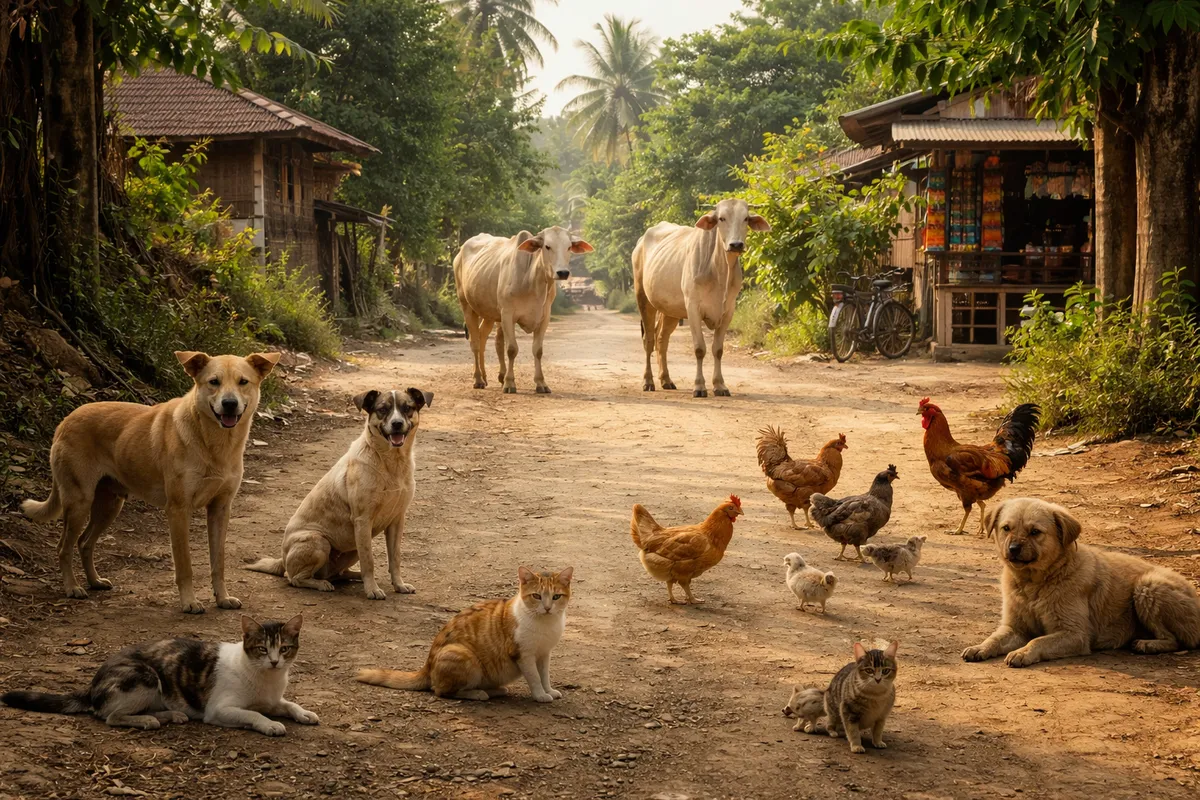
Witness the unofficial wildlife of the rural Philippines: feral dogs, semi-feral cats, chickens that have achieved full philosophical detachment from human authority, and cows following the sacred art of going nowhere very slowly. Let’s take the grand tour.
Welcome to rural Philippines—where the animals roam free, the fences are decorative, and you will eventually step in something you didn’t see coming.
1. Feral & Free-Range Dogs: Barangay Security Systems (Malfunctioning)
In rural areas, dogs are everywhere—and owned by no one in particular, yet somehow by everyone when convenient.
Typical Characteristics
- Ownership status: “That’s our dog” when it bites a stranger. “Not our dog” when it bites you.
- Diet: Table scraps, garbage, roadkill, and whatever tragedy wandered too slowly past the sari-sari store.
- Healthcare: Zero. Vaccinations are a concept, not a practice. Rabies is more common than you get in North America or Europe.
- Breeding: Unchecked, enthusiastic, and apparently sponsored by fate. The neighbor has eight dogs. Eighteen months ago, it was three. Right now, 2 are female, the rest are male. My security camera system has hours of this pack engaging in intercourse. After eating and barking, this is what they spend most of their time doing. There favorate place to do it is at our front gate, apparently.
Behavior
- Bark at motorcycles like they’re defending Helm’s Deep.
- Sleep in the road at night, daring vehicles to test destiny.
- Form packs that look intimidating but scatter instantly if you bend down and pick up a rock.
Social Role
- Early-warning alarm (always on, rarely accurate).
- Territorial enforcers of invisible boundaries.
- Occasional rabies roulette wheel 🎯 (rare, but not rare enough to ignore).
Reality check: Many are friendly, but you treat all of them like they might decide today is the day they rediscover their inner wolf.
2. Cats: Feral, Semi-Owned, and Completely Indifferent
Cats in rural Philippines exist in a quantum state between pet and pest.
Typical Characteristics
- Ownership: They live near people, not with them.
- Feeding: Someone feeds them. No one admits it.
- Sterilization: Almost nonexistent, hence the never-ending kitten factory.
Behavior
- Excellent rodent control (the one thing they consistently excel at).
- Appear silently, stare judgmentally, disappear.
- Give birth in places you didn’t know existed, like inside stacked hollow blocks. We had a mama cat setup camp under our outdoor staircase where all the leftover building materials are stored. That one cat found a way to get through the gates—probably safer there than on the other side with the dogs.
Survival Strategy
- Keep numbers high.
- Stay small.
- Avoid emotional attachment.
Bonus: Cats are generally tolerated because they kill rats. If rats ever unionize, cats would be instantly promoted to “valuable community asset.”
3. Chickens: The True Rulers of the Countryside 🐓
Chickens are not pets. They are not livestock. They are free agents.
Typical Characteristics
- Ownership: Nominal. Someone claims them until they die mysteriously.
- Containment: None. Fences are a suggestion.
- Reproduction: Constant. Roosters outnumber common sense.
Behavior
Wander into roads and stop dead center, daring vehicles to negotiate.
Scratch through your garden like it personally offended them.
Roosters crow at:
- 3:00 AM
- 4:00 AM
- Any moment you are trying to sleep or think.
Social Role
- Emergency protein reserve.
- Alarm clock nobody asked for.
- Fertilizer distribution system (uncontrolled).
Important rule: If you hit a chicken with a vehicle, it becomes an international incident.
Why This Exists (Short Answer: Poverty + Culture + Priorities)
- Veterinary care is expensive relative to rural incomes.
- Animal control is minimal to nonexistent.
- Animals are viewed practically, not sentimentally.
Survival > aesthetics > comfort > animal welfare.
This isn’t cruelty so much as benign neglect institutionalized by economics.
4. Cows: The Sacred Art of Going Nowhere Very Slowly 🐄
In rural areas, cows aren’t “loose.” They are temporarily elsewhere.
Ownership (Technically)
- Every cow belongs to someone.
- That someone is never present.
- Identification is done via vibes, memory, or heated argument—not tags.
Most are tethered during the day, then mysteriously untethered at night like some kind of agricultural Batman.
Behavior
Walk in roads because roads are flat, dry, and clearly built for cows.
Stop in the exact worst possible place:
- Blind curves
- Bridges
- Narrow barangay roads
- Stare at vehicles as if you are the trespasser.
They move only when:
- They feel like it.
- Someone pokes them with a stick.
- A motorcycle revs aggressively (results vary).
Diet & Damage
- Grass, rice stubble, gardens you worked on for months.
- Banana plants: shredded.
- Decorative plants: annihilated.
- Fences: laughed at.
If your property isn’t fenced like a prison yard, congratulations—you now operate a free-range salad bar.
Road Hazard Status
Cows are:
- Unlit
- Unmarked
- Uninsured
- Often invisible at night until physics intervenes
Motorcycle vs cow is not a contest. The cow usually wins. Gravity handles the rest.
Critical rule:
If you hit a cow, it is always your fault—even if the cow was asleep across the road like a sentient speed bump.
Cultural & Economic Reality
Cows are mobile savings accounts. I’m reminded of the Two Cows Explanation of Economics.
One cow can represent months or years of income.
Killing or injuring one is not “an accident”—it’s a financial crisis.
Expect:
- Angry owners appearing from nowhere.
- Demands for compensation.
- Barangay mediation that somehow concludes you should pay.
Nighttime Bonus Horror
Cows love to:
- Wander at dusk.
- Lie down in roads at night.
- Blend perfectly into the darkness like stealth tanks.
Headlights help. Common sense helps. Speed does not.
Practical Survival Tips (So You Don’t Ruin Your Life)
- Slow down in rural roads—especially at night.
- Assume every blind corner contains a cow.
- Fence your property like you’re keeping dinosaurs out. I’ve got a two meter high, 30cm thick wall around the entire property.
- Do not touch, chase, or “relocate” a cow. That way lies drama.
- Learn whose cows are whose. This is rural diplomacy 101.
Final Thoughts on Cows
Cows in rural Philippines are:
- Not pets
- Not wild
- Not supervised
- Not in a hurry
They operate on cow time, which is slower than Filipino time and utterly immune to horns, headlights, or your personal plans.
Practical Advice for Expats (Read This Twice)
Never assume an animal is vaccinated.
- Avoid feeding unless you’re ready to own the problem forever.
- Secure your trash like it owes you money.
- Expect noise, poop, and chaos.
- Learn which chickens belong to whom (this is not optional).
- Same with the cows.
Final Summary
- Dogs: Loud, territorial, occasionally dangerous, mostly bluff.
- Cats: Efficient, invisible, emotionally unavailable.
- Chickens: Utterly lawless.
- Cows: Not in a hurry. Not supervised. Just there.
They are not pests.
They are not pets.
They are features of the environment, like humidity and brownouts.
Thinking of Moving to the Philippines? Get Reliable Guidance
Online communities are helpful for general questions. For anything important, you still need accurate, professional, and updated information. E636 Expat Services helps foreigners with:
- Residency and long term visas
- Bank account opening
- Health insurance guidance
- Real estate assistance
- Business setup
- Retirement planning
- A smooth and secure transition into life in the Philippines
If you want to move with confidence instead of relying on random comments online, we can guide you every step of the way.
Book a consultation with E636 and start your journey the right way.