Whole-Home Battery Backup Solutions
utilities 09-12-2025
Introduction
This post is not a full review of any of the products mentioned here. None of these products discussed in this post were provided by the manufacturer or any other third-party. The products mentioned here may or may not make sense for your situation.
So, you are living in the rural Philippines or even a more urban area and the power goes out fairly often. I touched on this topic briefly in a previous post where I was talking about recent issues with my generator. Having stable power can be a challenge in an under-developed (maybe I should call it “developing”) region. If you want to increase your chances of not seeing these problems, I’d recommend choosing a more urban area of the Philippines to call home. If, like me, you want to carve out a reliable power situation and still enjoy the benefits of living in a rural area (the provinces) such as:
- Lower cost of living overall.
- Less traffic
- Natural beauty
- Slower pace
Then, you are going to have to put some effort into it. So, here we are, let’s talk more about resiliant electrical power. As we’ve noted a couple of times, if you want / expect your home amenities to be exactly like they were back in California (or wherever you are from in North America or Western Europe), you are going to spend quite a bit of money.
It all comes down to what your priorities are and the type of lifestyle you want to live—balanced against cost-of-living, your budget, and how much attention you are prepared to attract. In the area where I live, I don’t think I’ve seen five other foreigners in the past year—I am out in the middle of nowhere. I am intentionally not saying exactly where. It is fairly representative of the “provinces” as urban-dwelling Filipinos affectionately refer to the rural areas of the country (pretty much anywhere outside of the National Capital Region (NCR) or Manila
The electrical power standard in the Philippines is 220V and a frequency of 60Hz. It’s common to see both US and EU style plug types here. Though, don’t be fooled by the US style plug and thinking that you have 120V available from that plug. Important safety tip: many of the electronics sold in the USA only support 120V. By “only supports”, they mean it will burst into flames if you put 220V power through it. I’ve fried a couple of things this way.
In our city, the power can be out for six – twelve hours per week on average. It fluctuates throughout the year—during the rainy season, it tends to be more. Also, the power is scheduled to be shutdown ahead of time for typhoons and major tropical storms. You can expect the power to be out following earthquakes, volcanic eruptions, and other natural disasters as well, which happen frequently here in the Philippines.
For my personal needs, I wanted a system that can recover quickly from a power outage, but I’m willing to forgo some automation in the name of saving some money. This also makes for simpler parts and fewer things that can break. For example, flipping over to generator power (which I only do for extended outages) is a manual process. That manual process includes:
- Wheel out the generator
- Pull off the cover.
- Check oil and fuel.
- Start.
- Let it run for a few minutes.
- Switch over the power to the generator feed using the manual transfer switch.
When commercial power has been restored, which we identify by looking at the neighbor’s house’s lights, it is again a manual process to fail back to commercial power. Again, this is for the generator. When batteries are used, everything is automatic for both failover and failback.
My Battery System
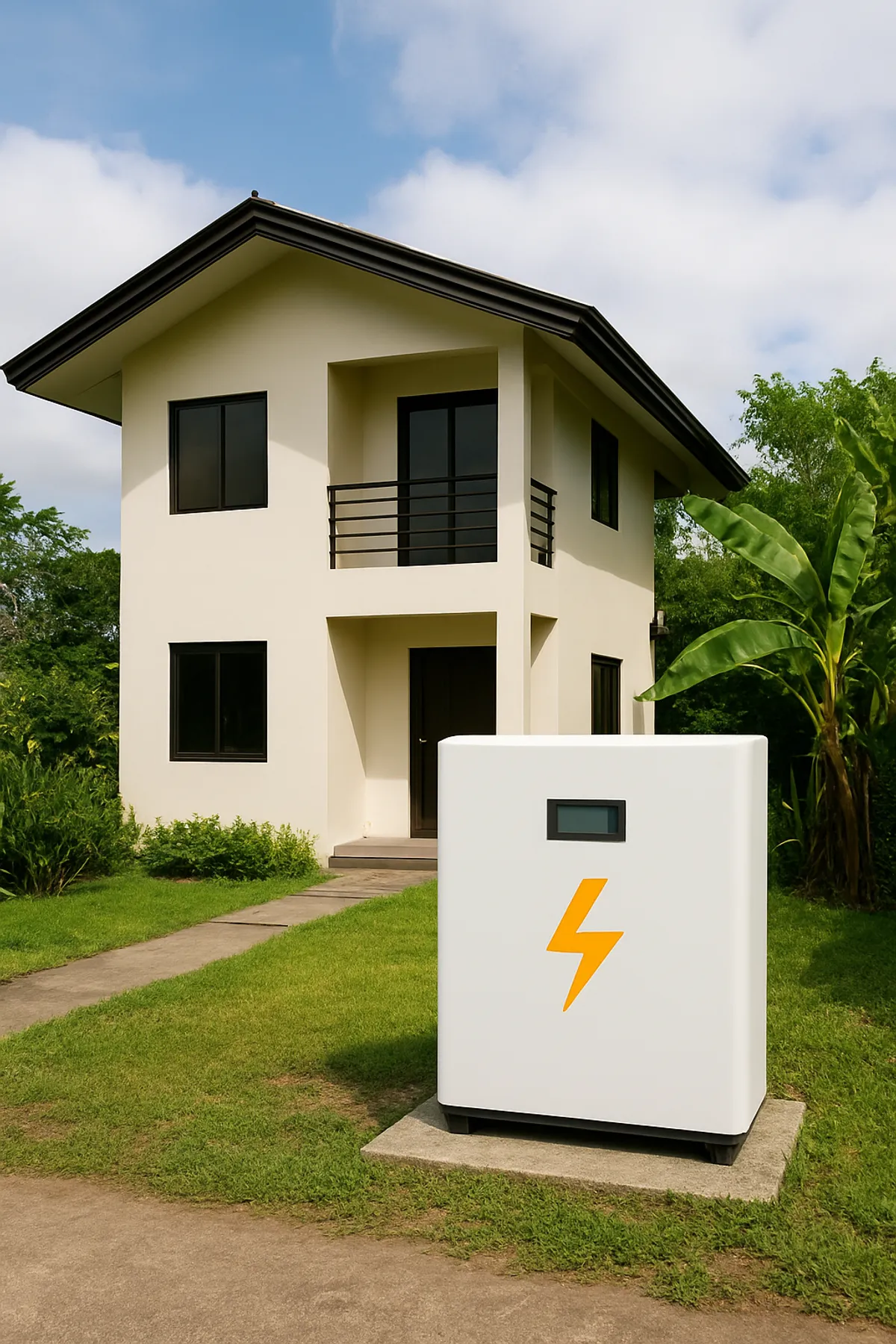
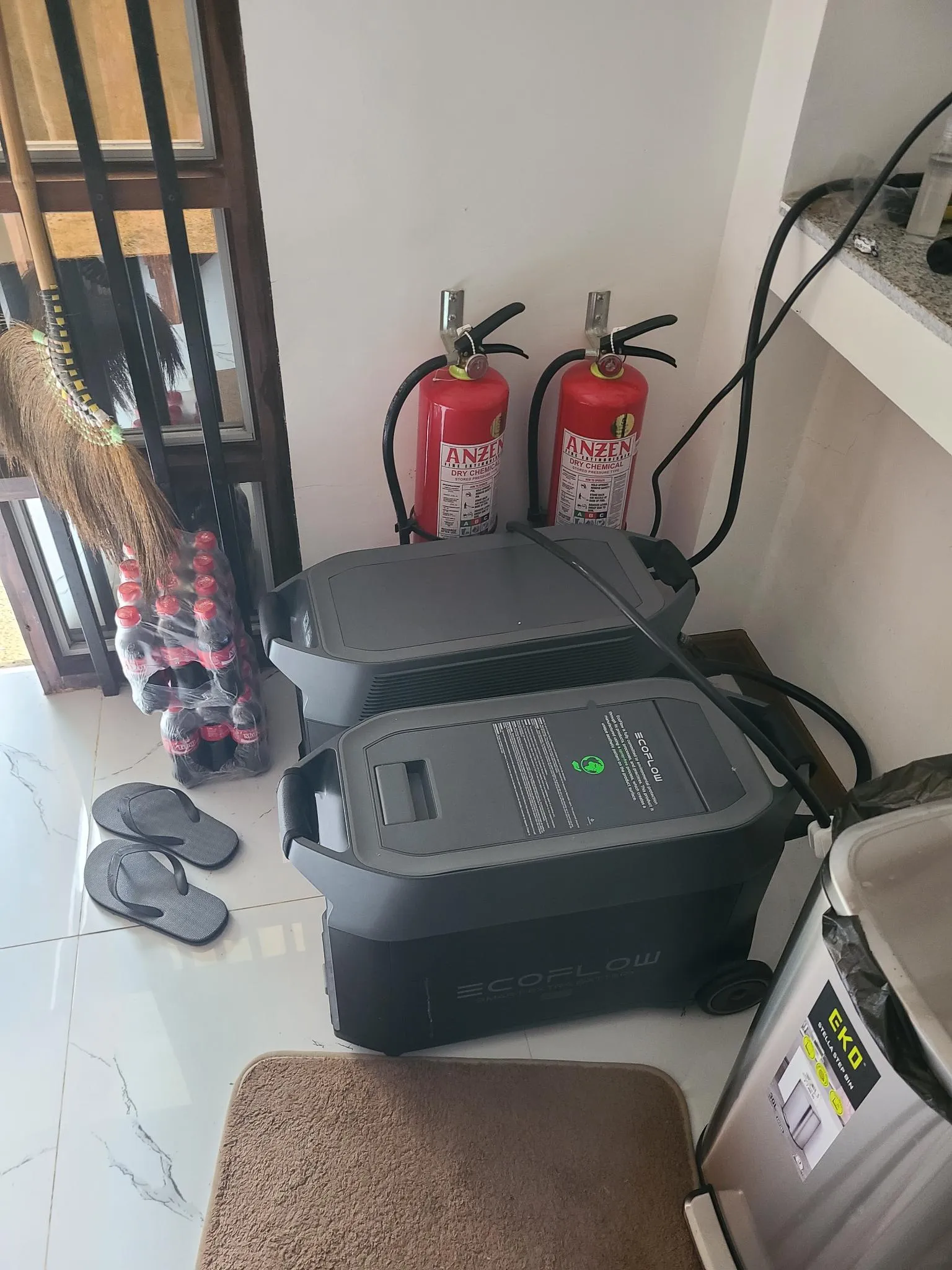
My whole home battery backup solution currently consists of an Ecoflow Delta Pro (International Version) + Extra Battery option. I can expand that by one more extra battery in the future. Then, I could add a second one of those—for a total of ~25kWH for the house. There is a notable price tag that goes along with a battery bank that large. Ecoflow has also been more dependable than anything that I can find locally.
At the moment, I do not have a solar power charging system installed, but that is on the list. I prioritized the battery system and diesel generator from a practical standpoint. I need a stable source of power. I do see solar as an important secondary source of power, but it probably won’t be my primary source of power for the house in what I build in the future. Most likely, I will build out 2000watt solar panel array (plus, charge controller) that can be used to charge the batteries. Not the greenest option, but trying balance practicality and keeping the lights on.
The following photo shows the Ecoflow Delta Pro + Extra Battery sitting near our electrical panel.
I want to build a little closet to put those in (well ventilated, of course). We’ll eventually need more room as the battery capacity expands.
The next photo shows the power management equipment we have in the house. The main panel box is in a kitchen cabinet.
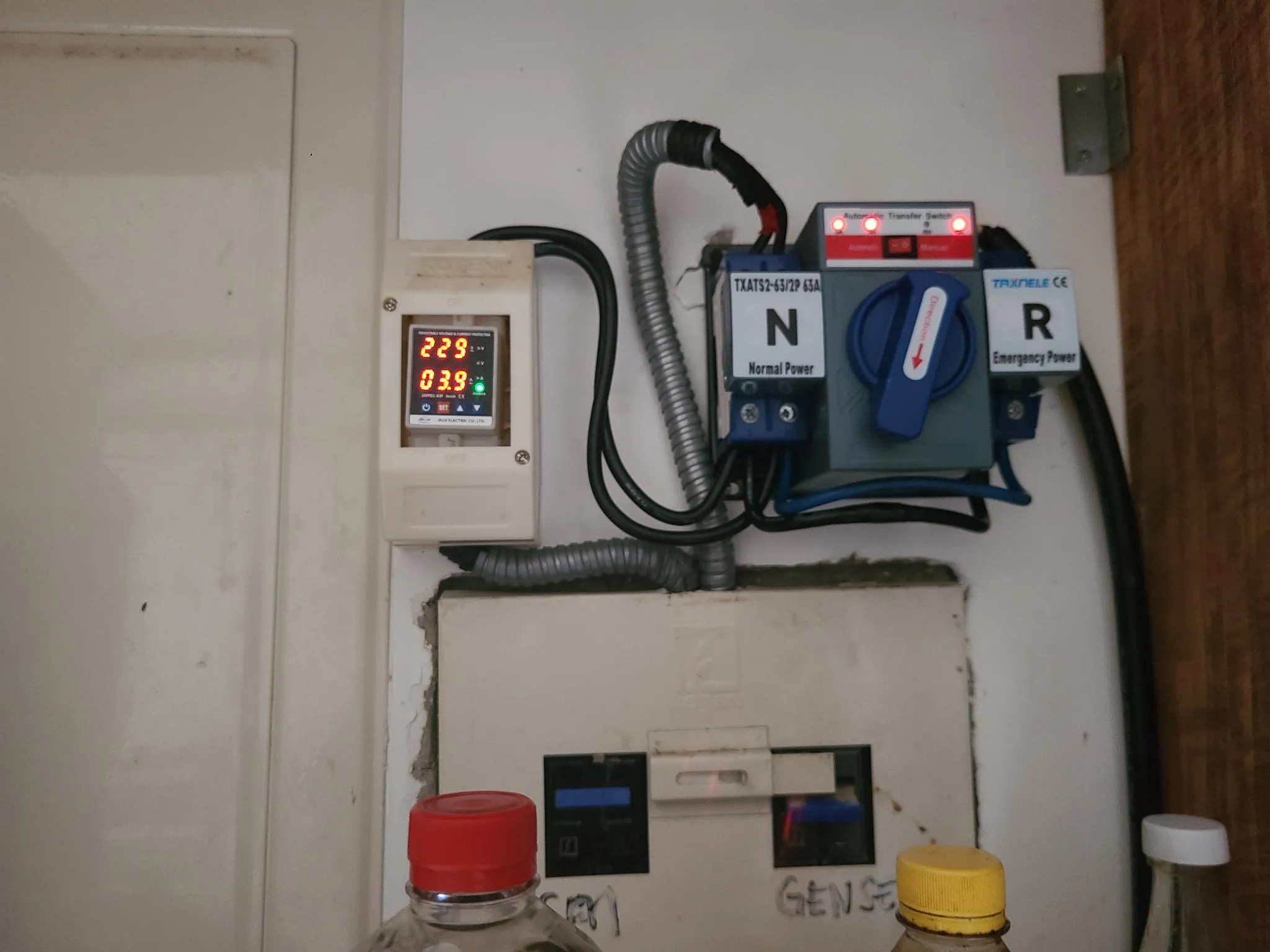
There is an automated transfer switch (Taxnele XATS2-63/2P 63A model) that automatically swaps between commercial power and the battery bank when commercial power goes out, which it does frequently. This transfer switch has two sources of power feeding it: the battery bank and the power coming from a manual transfer switch.
The commercial power main feeds into the manual transfer switch (a Koten MTS Manual Transfer Switch) below the automated transfer switch. The second source of power feeding this transfer switch is the generator. There is a cable that leads from the generator into this switch. This manual transfer switch allows us to swap between the diesel generator power feed and commercial power. So, switching to the generator is a manual process.
The manual transfer switch feeds a time-delay surge protector (TAXNELE 63A 230V Voltage Protector) that was recommended by the electrician. This protects against under voltage and over current conditions. It’s set to a ten second (configurable) delay. So, whenever the power goes out, it takes ten seconds for the system to flip over to battery power. You can see from the read out in the picture below that the house is currently drawing 3.9 amps at 229V (893 watts).
The surge protector than feeds the power main going into the circuit breaker panel.
This setup has grown over time and we’ve changed parts out as we’ve added new features / capabilities to the system.
If you are an electrician or electrical inspector in the USA or Western Europe, I can appreciate the thoughts going through your mind at the moment—had to start somewhere learning this stuff. One is not necessarily going to find all the skill sets needed to build a system like this in the rural Philippines. That’s one of the reasons I started E636 Expat Services. We can help you plan and design the system ahead of time rather than you figure it out one expensive mistake at a time.
In the USA, I used two Ecoflow Delta Pro units each with an Extra Battery attached for a home backup solution before I moved to the Philippines. I bought each of those used from the eBay Ecoflow Official Store over the course of about eighteen months. Since I left the US, those batteries are powering the backup solution for my server rack I keep in my friends house—that’s another story, for another post. I also have an Ecoflow Delta Pro + 2 X Extra Batteries setup in my parents basement as a whole house battery bank and backup solution; their house has an Ecoflow manual transfer switch—the power goes out a couple of times a year there. My dad had the lights, furnace electrical circuit, and living room television wired up to the backed up circuits.
I ordered the Ecoflow batteries directly from the Philippines Ecoflow website. Ecoflow does have an official store on Lazada an Shopee, but I rarely see the Ecoflow Delta Pro units on there. As I said in previous blog posts, I’m not comfortable ordering expensive items on Shopee or Lazada. At least ordering them straight from the manufacturer’s website feels like I’m eliminating some of the layers of bureaucracy in the shipping and return process.
The Ecoflow Delta Pro is one of the older models. New units are still sold, but the price is steadily decreasing. The lowest price I’ve seen offered for a new Ecoflow Delta Pro is 87K PHP. I’ve found the Ecoflow Delta Pro units to be generally dependable; so, I’ve continued buying those for new use cases. At some point, I’ll start using one of the newer models. Admittedly, the newer models can scale to much larger total storage that is managed by a single unit. Though, I still like the idea of building in as much redundancy to the system as possible. So, have multiple primary / controller units with the additional capacity spread out between each.
I’ve also looked at buying batteries directly from Chinese manufacturers that supply batteries for DIYer offgrid power projects. I’ve always been more comfortable going with the high-end battery solutions, but some day, I would like to deploy a custom DIY solution for the whole-house battery bank.
The Ecoflow Delta Pro has a US, EU, and International version. The EU or International version can be used in the Philippines. I have an International version. The Extra Battery option doesn’t seem to care which version of the main unit is bought.
The specs for the Ecoflow Delta Pro are available on the website. Scroll to the bottom.
The Ecoflow Delta Pro is the battery, Battery Management System, and Inverter.
Ecoflow provides an app for your phone that allows for remotely controlling and monitoring the batteries. Here’s a screenshot:
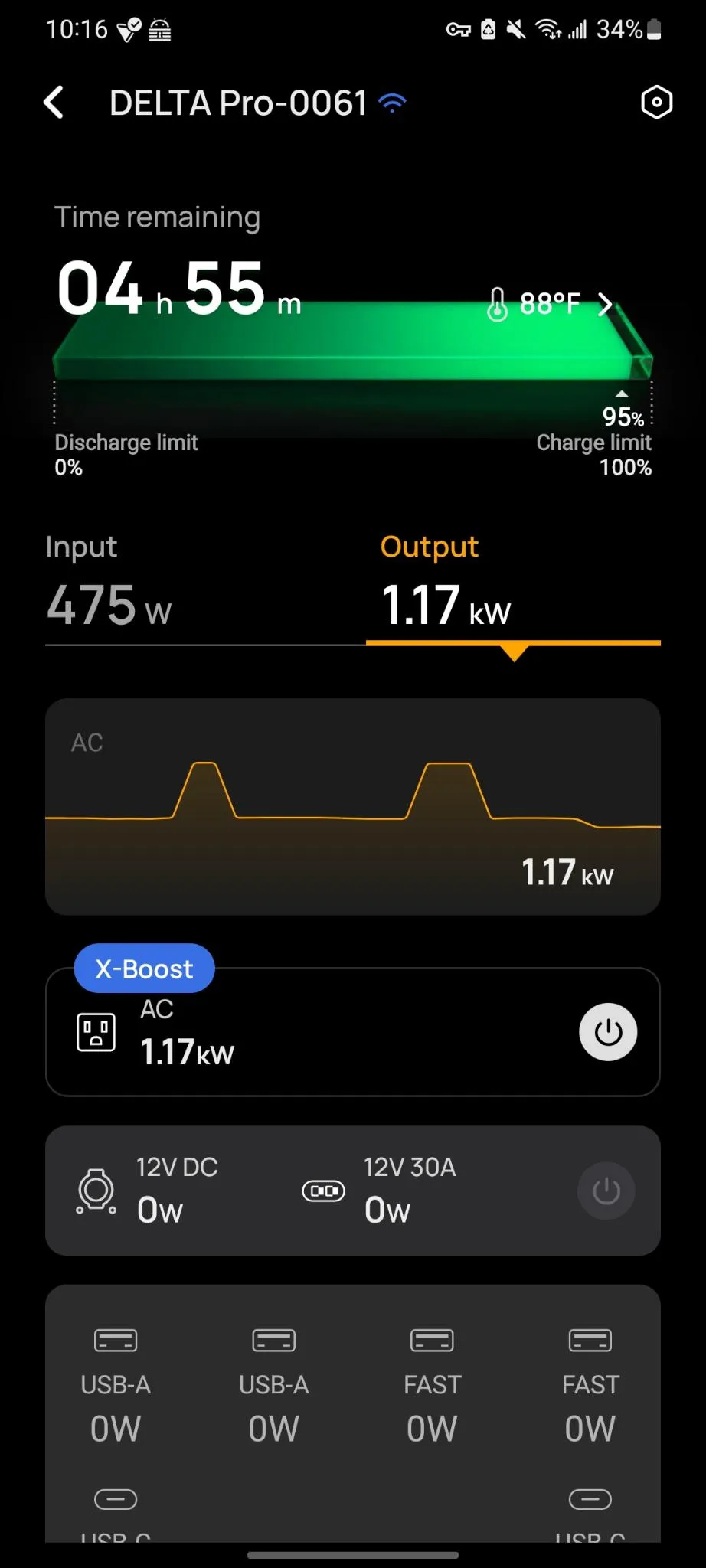
From the app, one can:
- Control the charging power level.
- Enable / disable power ports
- Discharge power level.
- Charging power level.
In the screenshot above, you can see that the extra battery is providing 475 watts to the main unit, the breaker panel is pulling 1.17kW from the unit (all through the AC outlets), the battery is 95% charge remaining, and at the current power consumption level the battery will last for another 4 hours and 55 minutes.
Our Power Usage
I’ve never done a detailed analysis of the power consumption of each appliance. We have roughly the following power usage:
| Appliance | Power usage |
|---|---|
| 3X aircon units | 700-1500 watts each; 2100 – 4500 watts total |
| Server rack | 300 watts |
| External lights (not solar) | 200 watts |
| Internal lights | 500 watts |
| Refrigerator | 350 watts |
| Deep freeze | 500 watts |
| Well pump* | 2000+ watts |
| 3X hot water heaters | 1000+ watts each; 3000+ watts |
| Starlink Router | 20 watts idle; 50-75 watts (typical usage) |
| Charge ecoflow batteries | 2700 watts |
| 2X Bathroom exhaust fan | 35 watts each; 70 watts total |
| 2X AppleV | 6 watts each; 12 total |
| 2X televisions | 120 watts (65”) + 65 watts (42”); 185 watts total |
| Total | ~14.4kW |
| *It runs whenever water is running from a faucet. It tends to run for short periods of time. There are two well pumps—one for the first floor, one for the second floor. Honestly, not sure if it is one well pump running at a time that pulls that much or if it is both of these together. That’s something I will research for a future post with more concrete numbers. |
The generators I have are 5500watts and 6500watts. I usually use the 6500watt generator as the primary generator. The Ecoflow batteries have a maximum discharge rate of 3600watts; however, it has the X-Boost features that allows temporary spikes in power consumption. I’ve seen this shoot up to 4500watts. Given this capacity, we can do most routine things we would do if commercial power was online, but we cannot necessarily do every routine activity at the same time when running on battery or generator.
As I recall, the first time we were running on generator when I took a shower, there was one aircon unit, the hot water heater, the well pump, lights, and other smaller things. We did trip the breaker on the generator.
There are no additional circuit breakers other than what the Ecoflow batteries and generator offer. I know those work. Among the parts I keep on hand is fuses and circuit breakers for the generator models that I own.
Additional Things I’ve Encountered Along The Way
-
When charging the batteries, it is very important to ensure that either:
- You have a separate circuit from the main breaker panel that is not part of the backup power solution involving the battery bank; or
- you unplug the power line feeding the transfer switch from the battery bank.
-
Otherwise, if the commercial power goes out and the automated transfer switch flips over (after the ten second delay induced by the time delay relay), a situation will be created where the battery is feeding the circuit that is trying to charge it. This will create what I believe is called a floating ground. The Ecoflow Delta Pro has circuitry that can detect this and will shut the unit down before any damage occurs. Once that happens, your whole house battery solution is an expensive paperweight until the wiring is adjusted. Rather than rely on this failsafe mechanism, it would be better if you never allow it to happen. This is an example of the types of tradeoffs being made when you assemble a lower cost system as I have done here.
-
I had a lot of trouble with charging the Ecoflow batteries from generator power early on. It’s worked a couple of times, but most of the time, the Ecoflow Delta Pro main unit just clicks about every five seconds. I don’t leave it in that state for very long out of fear of damaging it, obviously. I did two things that got the Ecoflow Delta Pro batteries to charge consistently:
- I bought a grounding rod and wire to hook up to the generator when it runs.
- I bought a pure sine wave inverter to run power through for charging the ecoflow batteries. I bought a pure sine wave inverter that took DC power that was rated at 3000 watts. The Ecoflow batteries have to charge slower with this setup, but it works.
-
Between these two things, the Ecoflow Delta Pro units can charge reliably and consistently with my generators.
-
There’s discussion in the forums that these are requirements for the Ecoflow batteries, but it doesn’t explicitly say this in the documentation. I’d love to explore this further, but I don’t really want to experiment on my equipment—these things are rather expensive. For what I’ve spent on batteries and generators, I could have bought another piece of land.
-
In my office, where I keep the server rack and other pieces of equipment that I brought from the USA, I had a need for 120V power. So, I have a voltage converter (5000watt max) that provides power to my server rack and a couple of US-style power outlets that run USA power specs. This way, I have a solution for running anything that only supports USA power specs.
-
I’ve got spares for all the parts I’ve mentioned in this blog post, except for the Ecoflow batteries. When things break unexpectedly, this helps get the system back up and running quickly.
-
The EU and International versions of the Ecoflow Delta Pro support both 50hz and 60hz power frequency. The Philippines uses 60hz (like the USA). The EU uses 50hz. If the unit is configured for 60hz power, you will see a “60hz” icon on the lower-center console on the main unit. If you don’t see this, you can long press the AC output switch for 10s to switch the frequency.
Summary
My whole home backup battery solution continues to evolve. Future steps will include:
- Adding solar panels to charge the Ecoflow batteries.
- Buying more Ecoflow batteries.
- Expanding the system to run the whole house off battery and solar. Each design decision in your system is a trade off between cost, reliability, and automation.
Thinking of Moving to the Philippines? Get Reliable Guidance.
Online communities are helpful for general questions. For anything important, you still need accurate, professional, and updated information. E636 Expat Services helps foreigners with:
- Residency and long term visas
- Bank account opening
- Health insurance guidance
- Real estate assistance
- Business setup
- Retirement planning
- A smooth and secure transition into life in the Philippines
If you want to move with confidence instead of relying on random comments online, we can guide you every step of the way.
Book a consultation with E636 and start your journey the right way.