Camiguin: The Island Born of Fire
culture24-06-2026
Camiguin is a small island in the Bohol Sea built almost entirely by volcanoes, with fewer than 100,000 people living around its edges. It sits about 10 kilometers off the northern coast of Mindanao, and most foreigners who have heard of it know exactly one thing about it: there is a cemetery under the sea.
This post is part of our “Off the Map Philippines Adventures” series, where we look at regions most tourists skip—their culture, festivals, food, and the sites worth the trip—and then get practical about what it takes to visit or live there.
Camiguin calls itself the “Island Born of Fire.” For once, the tourism slogan is literally true.
Camiguin at a Glance
- Province: Camiguin, part of Region X (Northern Mindanao)
- Capital: Mambajao, also the largest town
- Municipalities: Five—Mambajao, Mahinog, Guinsiliban, Sagay, and Catarman—with 58 barangays between them
- Population: 94,892 (2024 census)
- Area: Roughly 238–241 square kilometers, depending on the source
Camiguin is the second-smallest province in the Philippines by both population and land area, after Batanes. A national road circles the island, and the loop is about 64 kilometers. You can drive it in an afternoon, which is part of the appeal.
Language
Most people speak Cebuano (Bisaya). English and Tagalog are widely understood, especially in Mambajao and in the tourism trade.
The island also has its own indigenous language, Kinamiguin (also spelled Kamigin or Kinamiging), a Manobo language that is distinct from Cebuano. It is in decline. A 2016 study of speakers in Sagay found that even bilingual families mostly use Cebuano at home, with friends, and in church—although most respondents said they wanted the language preserved. If you hear an older person in Sagay or Guinsiliban using words you cannot find in any Cebuano dictionary, that is probably why. (Our post on Filipino Languages explains why this happens across the country.)
The Volcanoes
The island is built from several stratovolcanoes stacked together. Sources vary on how to count them—four main volcanic centers is the common figure, though some tourism material says seven when smaller cones and domes are included.
Only one has erupted in recorded history in the way people remember: Mount Hibok-Hibok.
Hibok-Hibok
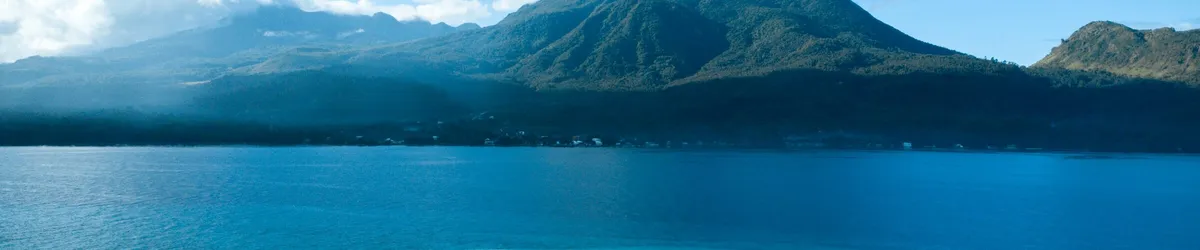
Hibok-Hibok rises above Mambajao and is one of the active volcanoes monitored by PHIVOLCS (the Philippine Institute of Volcanology and Seismology). Its deadliest eruption was on December 4, 1951, when pyroclastic flows—fast, ground-hugging avalanches of hot gas and ash—swept down its slopes.
The death toll is genuinely uncertain. The provincial government’s own account puts it at over 3,000. Other government and academic sources give figures from “more than 500” to “hundreds.” What every source agrees on is the consequence: the disaster pushed the national government to create the Commission on Volcanology in 1952, which later became PHIVOLCS. In July 2026, PHIVOLCS marked the eruption’s 75th anniversary with a commemorative marker in Mambajao.
The last eruption was in 1953. Hibok-Hibok is quiet today, but it is still classified as active and is still watched. The province has a volcanic eruption contingency plan, and it is worth knowing where your barangay’s evacuation route goes.
Mount Vulcan and the Sunken Cemetery
In 1871, after months of earthquakes, a new volcano opened up on the northwest side of the island near the old town of Catarman (in what is now Barangay Bonbon). It became Mount Vulcan, sometimes called Vulcan Daan (“old volcano”). The activity continued for several years, the old town was destroyed, and part of the land subsided into the sea—taking the town cemetery with it.
Sources disagree on the exact start date. Some give April 30 or May 1, 1871; the historical marker reportedly says May 13, 1871.
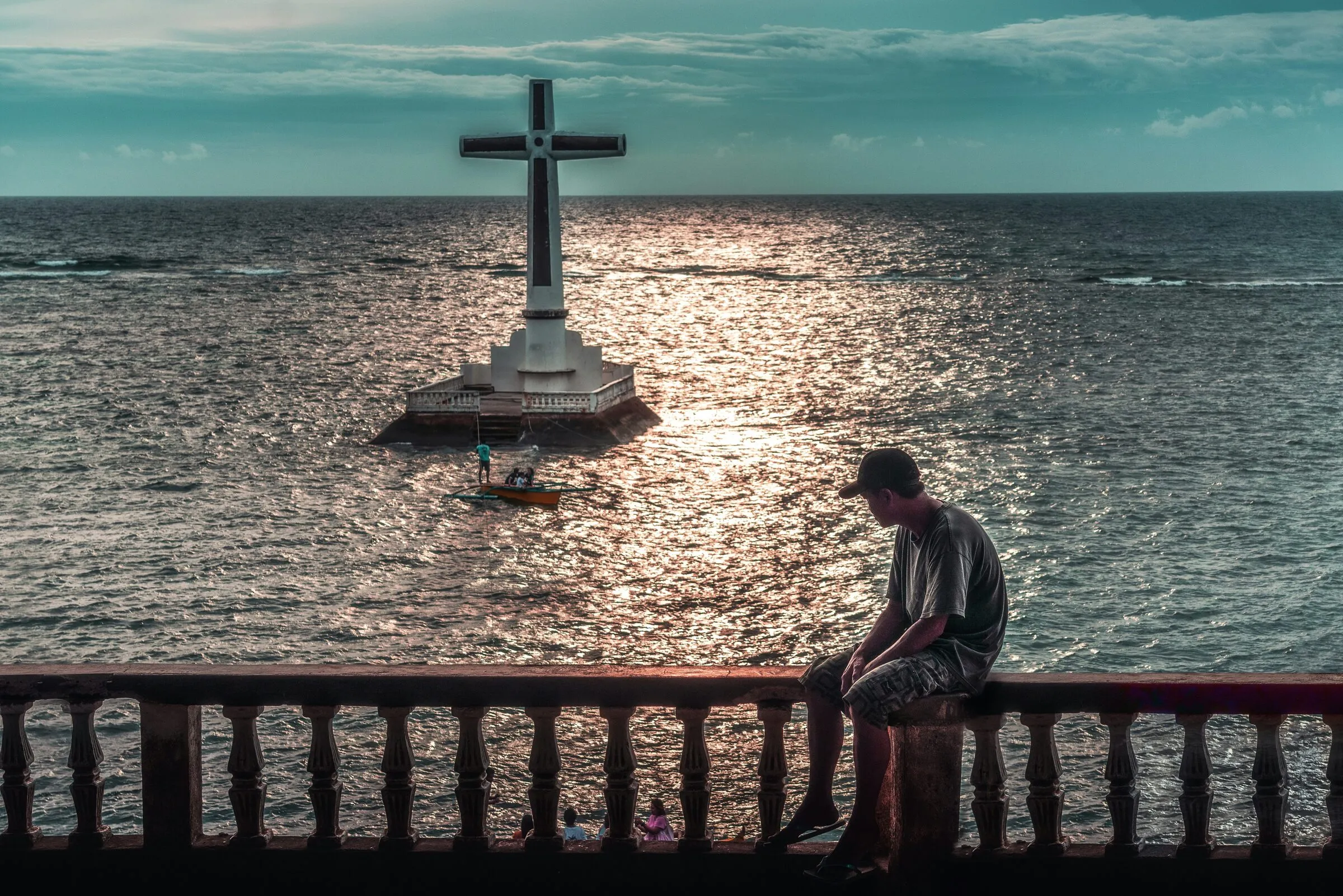
Today the site is marked by a large white cross built on a platform offshore in 1982. Boatmen take visitors out to it, and snorkelers and divers can see coral growing over what remains of the graves. The Sunken Cemetery is one of Camiguin’s three National Cultural Treasures, along with the nearby Old Bonbon Church ruins and the Spanish-era watchtower in Guinsiliban.
A few points of etiquette:
- It is a cemetery. People’s ancestors are down there.
- Sunset photos are fine; climbing on the cross or treating it as a diving platform is not.
- Pay the local boatmen’s posted fees rather than haggling hard—this is their livelihood.
Panaad: The Lenten Walk Around the Island
Camiguin’s biggest religious event is not a fiesta. It is a walk.
Panaad means “vow” or “promise” in Cebuano. During Holy Week, thousands of pilgrims walk all or part of the 64-kilometer circumferential road around the island as a penitential act, fulfilling a personal vow. Accounts differ on the exact window—some say pilgrims start as early as Holy Wednesday, others that most set out before dawn on Good Friday—but the walk is self-paced and people join from wherever they live.
The walk traditionally ends with a climb up the Walkway to the Old Volcano on the slopes of Mount Vulcan in Catarman, where life-size Stations of the Cross line the path. The climb up and back takes about an hour at an ordinary pace.
Holy Week is the island’s busiest time. Provincial tourism officials reported around 37,000 visitors during Holy Week in 2018. Expect full ferries, full guesthouses, and roads lined with walkers. If you are driving, slow down—especially at night.
The Lanzones Festival
The other big date on the calendar is the Lanzones Festival, held in Mambajao in October. It celebrates the harvest of lanzones (Lansium domesticum), a small, thin-skinned fruit with translucent segments. Camiguin’s lanzones are widely considered among the sweetest in the country, and the islanders will not hear otherwise.
What happens:
- Street dancing, with contingents in costumes made of lanzones and other native materials
- Agri-trade fairs and product displays
- Pageants and cultural presentations
- A great deal of fruit eaten, sold, and given away
The dances often retell local legends. One version holds that the lanzones fruit was once poisonous until it was blessed and made sweet; another centers on buahanan, the old local name for lanzones, and a tale involving children lured into the forest by a hornbill that was actually the Tagbusaw, a child-eating creature from local folklore. Different contingents tell it different ways, and nobody is keeping score on accuracy.
On dates: the festival is usually described as falling in the third week of October, but exact dates move year to year (the 2026 edition was reported as running October 18–25). Even the founding year is fuzzy—some sources say 1979, while the edition numbering (40th in 2019, 47th in 2026) points to 1980. Check with the Camiguin Provincial Tourism Office before you book.
The festival was cancelled in 2020 and 2021 because of the pandemic.
Hot, Cold, and Everything in Between
A volcanic island means geothermal water, and Camiguin has plenty:
- Ardent Hot Spring (Mambajao) – warm pools fed from the slopes of Hibok-Hibok
- Santo Niño Cold Spring (Catarman) – a large, clear, very cold spring-fed pool
- Bura Soda Water Pool (Catarman) – naturally carbonated spring water
- Tangub Hot Spring – near the Sunken Cemetery, partly submerged, where hot water mixes with the sea
- Katibawasan Falls – a single drop of roughly 76 meters (250 feet), about 5 kilometers from Mambajao, and a starting point for hikes into the interior
The interior highlands are protected as the Timpoong and Hibok-Hibok Natural Monument, which was declared an ASEAN Heritage Park in 2015. Hikes up Hibok-Hibok and Mount Timpoong require permits and a registered guide; arrange these through the local tourism or environment office rather than showing up at the trailhead.
White Island and the Sea
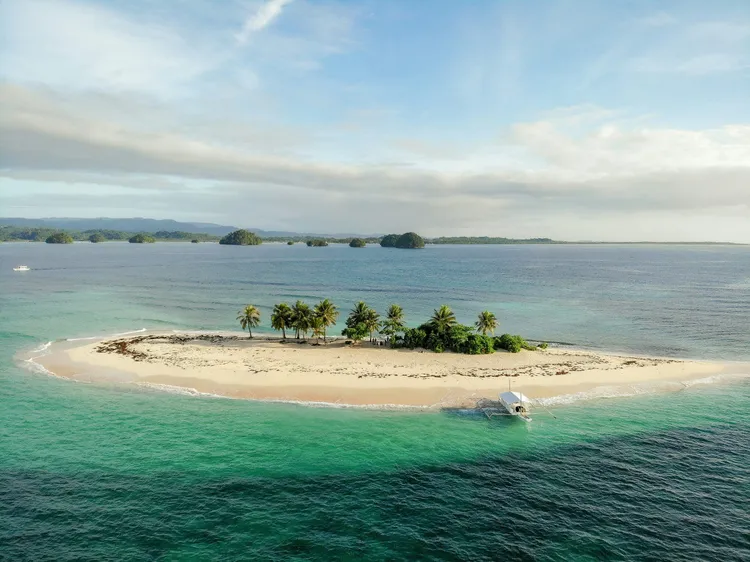
White Island is the postcard. It is a bare, shifting sandbar about 5 kilometers off Mambajao, reached by boat from Barangay Agoho. There is no shade and no structure, the shape changes with the tides and seasons, and the view back toward Hibok-Hibok is the shot everyone takes.
Practical notes:
- Go early. By late morning the sand is hot and the light is flat.
- Bring water, sun protection, and a hat. There is nothing to buy out there.
- Some sources say the sandbar can be partly submerged at high tide; ask the boatmen.
Other sea sites:
- Mantigue Island, a small forested island off Mahinog, popular for snorkeling
- The Kabila Giant Clam Conservation and Ocean Nursery, which reports keeping seven of the nine giant clam species
- Snorkeling and diving around the Sunken Cemetery and Mantigue
Food and Pasalubong
Two things leave Camiguin in suitcases:
- Lanzones – in season (roughly September to November), fresh and cheap
- Pastel – soft, sweet buns filled with yema (a custard of egg yolk, milk, and sugar). The best-known brand is Vjandep, a family business that the Department of Trade and Industry has profiled as a local success story. Accounts of the recipe’s origin differ: some credit the Jose family behind Vjandep, while older newspaper features credit the Bollozo family of Camiguin or trace it to Spanish-era baking.
Pasalubong, if you are new to the term, means the gift you bring home from a trip. Showing up from Camiguin without a box of pastel is noticed.
Beyond that, expect fresh fish, grilled seafood, and ordinary Cebuano and Mindanao home cooking. The island is not a culinary destination, and it does not pretend to be.
For Expats and Visitors
Getting There
There are three common routes:
- By air from Cebu. Cebu Pacific (operating as Cebgo) has flown the Cebu–Camiguin route, but frequency has been limited—some 2026 listings showed as few as one flight a week. Check the current schedule before relying on it. The airport is near Mambajao, and flights are vulnerable to weather; in February 2026 a flooded runway cancelled flights.
- Via Cagayan de Oro. Fly into Laguindingan Airport, take a bus or van to the port of Balingoan (about two hours from Cagayan de Oro’s Agora terminal), then a ferry to Benoni port in Mahinog. The crossing takes a little over an hour, weather permitting.
- From Bohol. A roll-on/roll-off ferry runs between Jagna, Bohol and Balbagon port in Mambajao.
Ferry schedules change and are suspended during storms. Confirm directly with the operators and the port before you travel.
Weather and Typhoon Exposure
Camiguin is further south than the main typhoon track, which hits Samar, Leyte, and Luzon hardest, but it is not immune. In November 2001, Typhoon Lingling (Nanang) caused flash floods and mudslides that killed about 200 people. Heavy rain is the real risk here: steep volcanic slopes and rivers that rise fast.
The drier months are generally February to May. Lanzones season (and the festival) falls in the wetter second half of the year.
Costs
Camiguin is cheaper than Boracay or El Nido, but it is a small island that imports much of what it uses, so expect island prices for fuel, some groceries, and imported goods. Tourist areas around Mambajao and the White Island coast are pricier than the rest. Renting a motorcycle or hiring a multicab or tricycle (see our post on the Filipino tricycle) is the usual way around the loop.
Connectivity and Power
Mobile data from the major carriers is available in the towns and along most of the coastal road, with weaker coverage in the interior and on some stretches of the south and west. Many resorts offer Wi-Fi; quality varies. If you need reliable work connectivity, test it before committing to a long stay, and have a backup.
Healthcare
Camiguin General Hospital in Mambajao is the island’s main government hospital and the referral point for the province’s district hospitals and rural health units. Its classification has varied in official listings, and a 2024 government report described it as working toward Level 2 status. For serious or specialist care, expect to be transferred to Cagayan de Oro—which means a ferry crossing and a road trip. If you have a chronic condition, plan accordingly. (See our post on the state of Philippine healthcare.)
Safety and Travel Advisories
Camiguin itself is generally regarded as a quiet, low-crime island. Travel advisories, however, are written for Mindanao as a whole, so read them carefully:
- The UK (FCDO) advises against all but essential travel to most of eastern and northern Mindanao, but specifically excludes Camiguin Island. Australia’s advice also excludes Camiguin.
- The US State Department’s Mindanao “Reconsider Travel” (Level 3) advisory lists exceptions such as Siargao and the Dinagat Islands, but in the versions we reviewed, Camiguin is not named among them.
- The usual mainland gateways—Cagayan de Oro and Balingoan—fall under the broader Mindanao advice for some governments. Flying direct from Cebu or taking the ferry from Bohol avoids mainland Mindanao entirely.
Advisories change. Check your own government’s current advice, and check whether your travel insurance is affected, before you go.
Natural hazards are the bigger day-to-day risk: volcano and earthquake awareness, flash floods in heavy rain, and strong currents around some beaches.
Etiquette
- Dress modestly in churches, at the Walkway to the Old Volcano, and away from the beach.
- During Holy Week, keep your noise and drinking down. Panaad is a penitential walk, not a party, and many towns treat Good Friday very seriously (see our post on Filipino holidays).
- Respect the Sunken Cemetery as a burial site.
- Ask before photographing people, especially pilgrims and older residents.
- Learn a little Cebuano. “Salamat” (thank you) and “maayong buntag” (good morning) go a long way.
Summary
Camiguin is:
- Small enough to circle in a day, and varied enough to fill a week
- Shaped—physically and culturally—by its volcanoes, from Hibok-Hibok’s 1951 eruption to the town that slid into the sea in 1871
- Devout, with Holy Week’s Panaad walk as its defining event
- Sweet in October, when the lanzones come in
- Excluded from some Mindanao travel warnings but not all, so check before you go
It is not a party island, and that is the point. People come for the volcanoes and the water, and most of them leave wishing they had stayed longer.
Thinking of Moving to the Philippines? Get Reliable Guidance
Online communities are helpful for general questions. For anything important, you still need accurate, professional, and updated information. E636 Expat Services helps foreigners with:
- Residency and long term visas
- Bank account opening
- Health insurance guidance
- Real estate assistance
- Business setup
- Retirement planning
- A smooth and secure transition into life in the Philippines
If you want to move with confidence instead of relying on random comments online, we can guide you every step of the way.
Book a consultation with E636 and start your journey the right way.
Image credits (via Unsplash, free under the Unsplash License):
- Top image: “a beach with a mountain in the background” by Nico Alumbro
- Sunken Cemetery photo: “Man sits overlooking a large cross in the ocean” by Bart Ros