The Time My Diesel Generator Broke Down During A Typhoon
diy 04-12-2025
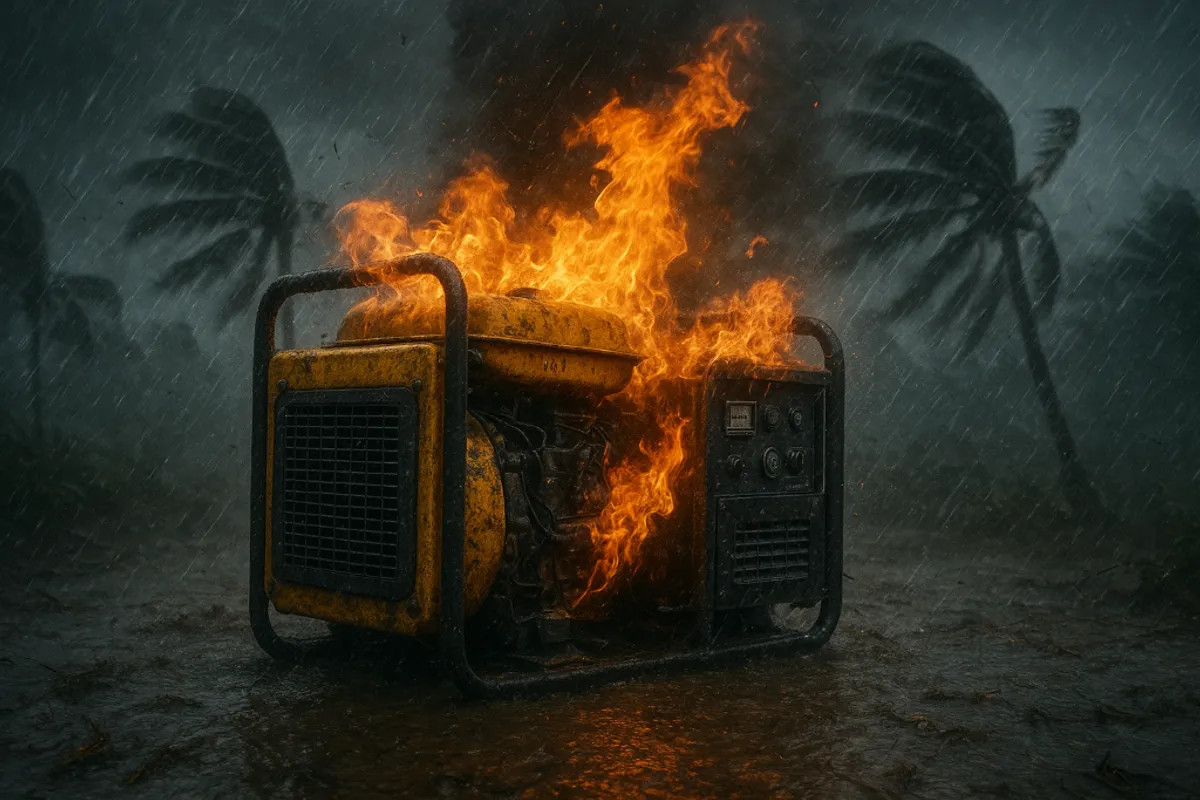
OK, in reality, the generator just sort of clunked out and I couldn’t get it to start again. It wasn’t quite as dramatic as the photo. Still, I like the photo’s raw emotion.
Before I tell this story, let’s level set some expectations. When I started living in the rural Philippines, I didn’t know what I was doing. Learning was a journey. This story in one part of that journey.
Properly maintaining a generator requires constant vigilance if you want it to be ready to work in an emergency.
The day I was in the hardware store shopping for my first generator, I had an elderly Australian gentlemen approach me. He asked me if I was building a house in the Philippines. We briefly chatted. His advice was that I figure out how to live out in the provinces without any real need for electricity rather than buying a generator. That’s one approach, but my career choice requires being able to run a laptop and high-speed internet connection reliably. So, I bought a generator that day.
There were two big typhoons that rolled through the Philippines in November, 2025: Typhoon Kalmaegi (known locally as Typhoon Tino), which formed on October 31 and caused extensive damage and fatalities, and Typhoon Fung-wong (known as Super Typhoon Uwan), which made landfall on November 9 and also resulted in significant destruction and loss of life. Both storms severely impacted the country, compounding recovery efforts from one another. Lucky for us, the eye (and strongest part) of the first storm was about 250km south of us and second storm’s eye was 150kms north of us as it passed. There was a lot of rain and a lot of wind, but it was manageable. We built our house in an area that does not generally flood. Though, there was several centimeters of water flowing through our concrete patio area. We need to adjust the drainage a bit from the original construction, but that’s a separate story for another post.
The local electrical cooperative (a non-profit that owns and maintains the local power grid) in the province where we live in the Philippines is unreliable. On average, we have several hours of power outages per week—this is not great, but normal for the rural Philippines. So, steps had to be taken to ensure we always have power. We have a whole house battery backup solution using Ecoflow Delta Pro batteries (with extra battery option). That’s a total of 7.2kWH with a maximum draw of 3.6kW (though there is an option where it can handle temporary spikes in power draw above that). This ties directly into the main breaker panel via an automatic transfer switch that has a time-delayed surge protector inline between the transfer switch and the breaker panel. It automates failover to battery (with a ten second delay) when commercial power goes out and automates failback when commercial power goes back online. This setup does not provide an uninterrupted power solution, but it does protect the appliances / electronics from power surges. If we run the minimum, the batteries can last for about ten hours. After that, we need to fire up the diesel generator.
There is a secondary manual transfer switch that allows for switching from the automated main + battery-backup system to the generator. We have enough diesel storage to run the generator for twelve hours per day for a week without needing to restock. This is enough for the batteries to recharge and last overnight, for most of the night.
In the future, I’m going to add:
- more diesel storage
- enough solar to rapidly recharge the batteries / run the whole house for a few hours during the day
- more battery capacity.
Since that second typhoon, I’ve added a second generator in case the first one dies. The ultimate goal is to eliminate all single points of failure, but that is really hard to do in practice.
My original diesel generator is a Shinsetsu SDG-50-OPT. Shinsetsu is a brand owned by Justino Corporation. Justino Corporation is a Filipino company that appears to outsource manufacturing to a variety of other firms in China (all the diesel engine designs are also generic brands that are sourced from China), Thailand (mentioned on the side of the generator), and other Asian countries—they don’t seem to manufacture in the Philippines. The Shinsetsu SDG-50-OPT model isn’t listed on the Justino Corporation website, but can can be found on the Shinsetsu Equipment website. I bought mine a few years ago, but you can still find that unit for sale in the Philippines. A few years ago, I paid about 90K PHP (~$1500USD). The basic specs for the SDG-50-OPT can be found here. One can typically find these units for sale, new, for between 70-85K PHP today.
One can find people sarcastically criticizing this brand of generator in Reddit forums. It’s a generic diesel generator, where trying to find the correct parts online can be nearly impossible. GeneratorGuru.com does have compatible parts for this model, but they all cost 5X – 10X as much as buying the same part here in the Philippines. Not to mention the possibility of packages getting hung up in Philippines customs for months—I only had that particular problem happen once. Furthermore, that site doesn’t include a part number that can be referenced anywhere else.
I’ve contacted several companies that sell Shinsetsu equipment about ordering parts for my generator model. The only company that ever said they can order parts from the equipment manufacturer charges far too much and it takes 1-2 months for the part to arrive. My goal is to find a local (Philippines-based) source of parts that can at least deliver something within a couple of weeks of it being ordered. Since everything the company sells seems to be imported, it stands to reason that all sources of product parts must also be imported. So, one would be looking for a Philippines-based Shinsetsu / Justino parts distributor that is large enough to keep common parts in stock without the long-international-supply-chain-delays.
I surely could find a more mainstream brand, but then there will be issues such as:
- likely higher cost.
- getting it shipped / transported here (which is the middle of nowhere) will still add notable cost.
- I’m not ordering a generator (large, bulky, will it work?) from Shopee, Lazada or similar online shopping sites. The process of returning a bad unit is too painful for a 150kg generator.
This generator had the benefit of being sold by mainstream hardware store in a city a few hours away by car, they would deliver it, and we could order parts for it; although, with the aforementioned difficulties with those orders. More than that, it was the display model that had the power output I was looking for, nothing else was available (late-stage pandemic supply chain disruptions, I suppose).
When I bought the generator, I didn’t have much experience with generators. I had a gasoline-powered generator in the US, but the power was very reliable and I didn’t have to use it very often. I only fired it up a couple of times. In my new life here in the Philippines, having a functioning generator has been much more important. Especially in terms of being able to perform basic job functions for this expat services business and other things I’m involved with that require a computer and internet connection. As we noted in the previous “Thinking Of Moving To The Philippines?” post, “A foreigner who insists on living like they’re still in California will spend like it too.” It’s like the old Australian guy said in the hardware store that day, don’t create a dependency on electricity.
So, since I bought the generator, I’ve set out to maintain it. This requires:
- knowledge of basic diesel engine repair
- documentation (repair manuals with diagrams and parts list)
- parts
- tools
Creating a collection of tools is admittedly the fun part. Of course, there is always the possibility of going overboard, but amassing can be fun. The challenge, besides space for the tools, is you are always buying the tool you needed for the last situation. Eventually, you start having the tool you need. Also, I cannot stress enough that any tool I do need is probably a multi-week-delivery, online order or a day trip to the closest city to visit a hardware store (that doesn’t sell garbage and would have what I need). Finding quality tools in the rural Philippines can be challenging. Most of my best tools I brought with me from the US—those don’t start rusting within days or weeks of being bought. At a minimum for diesel generator maintenance, one should have:
- Basic Hand Tools
- Wrench set (metric + SAE)—Most of the generators one finds in Asia will be entirely metric
- Socket set with deep sockets
- Screwdrivers (flat + Phillips—don’t use them as pry bars, genius)
- Pliers (needle-nose, slip-joint, locking)
- Electrical Tools
- Digital multimeter (measure volts, amps, etc)
- Clamp meter
- Insulated screwdrivers (eventually, something will short circuit, no point in getting electrocuted)
- Wire strippers and crimpers
- Engine-Specific Tools
- Oil filter wrench
- Fuel filter wrench
- Feeler gauges
- Torque wrench
- Compression tester for diesel engines
- Fluids & Handling Gear
- Oil drain pan
- Funnel
- Clean diesel-safe containers Hand pump for fuel transfer
- Cleaning & Inspection Gear
- Shop rags
- Parts cleaner / degreaser
- Brass brush (not steel)
- Flashlight or work light
- Inspection mirror (on a long telescoping pole)
- Magnetized, telescoping retrieving claw to pick up things dropped into the bowels of the generator.
- Safety Gear
- Gloves (your hands will still get filthy)
- Safety glasses (because diesel spray in the face builds character)
- Hearing protection if you insist on testing the genset at 6am
- Testing & Monitoring Tools
- Infrared thermometer (spot overheating before it becomes “why is it smoking?”)
- Hydrometer (if dealing with lead-acid batteries)
- Battery load tester
- Tachometer
- Fuel System Tools
- Primer pump (some engines require it)
- Clean syringe or suction pump for removing water from fuel bowls
- Diesel additive for cleaning injectors
Next up, you need spare parts. To perform general maintenance and fix whatever breaks at the most inopportune times. A good set of parts would be:
- Filters (Always keep spares)
- Oil filters (2–4 units)
- Fuel filters (primary + secondary, 2–4 each)
- Air filter (1 spare is fine unless you operate in a dust bowl)
- Water separator elements
- Breather filter (if your model uses one)
- Belts
- Alternator belt
- Fan belt
(Or a single serpentine belt depending on your engine)
- Fluids
- Engine oil (at least one full change worth)
- Coolant (premix, correct spec)
- Diesel fuel (small emergency stash)
- Fuel additive/biocide (Philippines = water & algae paradise)
- Gaskets & Seals
- Valve cover gasket
- Oil drain plug washer
- Fuel banjo bolt washers
- Thermostat gasket
- Exhaust gasket (optional but handy)
For most models, you can buy a complete set of replacement gaskets.
- Electrical
- Glow plugs (if your engine uses them)
- Fuses (all amperages used on your genset)
- Starter relay/solenoid
- Voltage regulator/AVR
- Battery terminals + spare wires & lugs
- Cooling System
- Thermostat
- Radiator cap
- Hoses (upper + lower)
- Fuel System
- Injector return hoses
- Fuel hose (1–2 meters of generic diesel-safe hose)
- Hose clamps (a big variety pack)
- Misc
- Engine mounts (if you’re feeling proactive)
- Rubber vibration pads
- Extra bolts & nuts (genset-specific, metric + SAE)
The recommended parts you stockpile will vary based on your diesel engine.
For my Shinsetsu generator, after a bit of research (it was a label on the side of the generator), it uses a SDE 186FA diesel engine That right there tells you a lot about compatible parts because the 186FA diesel engine design is fairly standardized across manufacturers based on what I’ve read. The 186FA diesel engine is a generic Chinese design that is used in a variety of products (and, again, has multiple manufacturers). Now, one might hope that the “SDE” moniker would help in tracking down parts, repair manuals, etc, but that is not how my online search went. When the starter motor assembly had to be replaced, I was able to find a compatible replacement part of Lazada Philippines by matching the 186FA engine name and starter motor power printed on the side of the old part. That’s how finding parts has been so far.
At this point, you are probably marking this type of generic diesel generator off your shopping list; however, most of the generators I’ve found for sale in hardware stores here in the Philippines, especially in the provinces fall into this category. Again, I’m not comfortable buying something as expensive / big / complex as a diesel generator on Shopee or Lazada. So, no perfect options here.
For building knowledge of generator repair and maintenance, nothing helps like need. If you buy a generator and want it to be available when you need it, you have to follow the prescribed maintenance schedule—oil, filters, batteries, fuel. The manual that came with my Shinsetsu SDG-50-OPT generator was 15 pages of poorly scanned incomprehensible gibberish that the manufacturer called English. I was able to get a basic maintenance schedule and recommended type of oil out of that booklet.
There are a couple of locals who know a bit about engine repair (mainly motorcycles, tricycles) and an electrician that have been able to help when there were generator problems. Each time I’ve called upon one of them for assistance, I watched what they were doing closely.
A couple of times, I made some educated guesses, disassembled some things, managed to put it back together correctly, and fixed the problem. This was mainly simple stuff. More often, these attempts resulted in a call to one of the local guys that know more than I do—live and learn.
Finding a repair manual for a 186FA engine has also proven difficult. Searching online turned up this and that. These are basically high-level notes for maintenance of tools that use some type of 186FA engine—the relevance to the SGT-50-OPT varies.
Anyway, given all of that background, during the second typhoon this month, we were able to run on battery overnight between when the power was cut and dawn the following morning. By 6:30am, I fired up the generator. There was still a lot of wind, some rain, but the bulk of the storm had passed. My plan was to run on generator until about 8pm that evening and then switch to battery again. Around 1pm, the generator ran out of diesel. I misjudged how much time was left on the current tank. Not a big deal. I filled the tank up. And, went to start it again. It wouldn’t start. The electric ignition had no power and the manual crank wouldn’t get it to turn over either (tried half a dozen times). The alternator built into the generator apparently stopped charging the battery. The battery had fallen down to about 11.5V. That wasn’t enough to get the starter motor to turn over the engine. I have a car battery charger. I used the Ecoflow batteries to run the car battery charger. It took several hours to fully charge the battery, but once it was at 12.8V, the starter motor was able to turn over the engine. I still couldn’t get it to start with the manual crank. I didn’t figure out that part. But, at least had a way to start the generator. As that came together around 7:30pm that night, the power came back on and the generator (and batteries) were no longer needed.
At the time of writing this, I haven’t found the correct part yet to repair / replace the alternator. About once a week or so, I charge the battery backup with the car battery charger. This is not a great long-term solution, but it’s what I’ve got for the moment. I’ve also bought a new Sunpor / Kipor KDE8800T diesel generator. It uses a 192F diesel engine design. The 192F engine has a similar generic parts ecosystem. Apparently, I can get parts through the store I bought it from.
I’m on a journey becoming the diesel engine / generator repair amateur that I need to be to make this situation work.
Thinking of Moving to the Philippines? Get Reliable Guidance.
Online communities are helpful for general questions. For anything important, you still need accurate, professional, and updated information. E636 Expat Services helps foreigners with:
- Residency and long term visas
- Bank account opening
- Health insurance guidance
- Real estate assistance
- Business setup
- Retirement planning
- A smooth and secure transition into life in the Philippines
If you want to move with confidence instead of relying on random comments online, we can guide you every step of the way.
Book a consultation with E636 and start your journey the right way.